

Publishing's Bellwether
A Throwback Article

This article was originally published at the Mad Genius Club on September 22, 2015. It’s been almost a decade, and this is still true. Probably always will be. Thing is, at this point the gatekeepers are still standing at the gates, oblivious to the fact the fences are down, have been for years, and the herds just flow around them and direct to the reading market. We’ve won, we really have. Indie Authors, you did it!
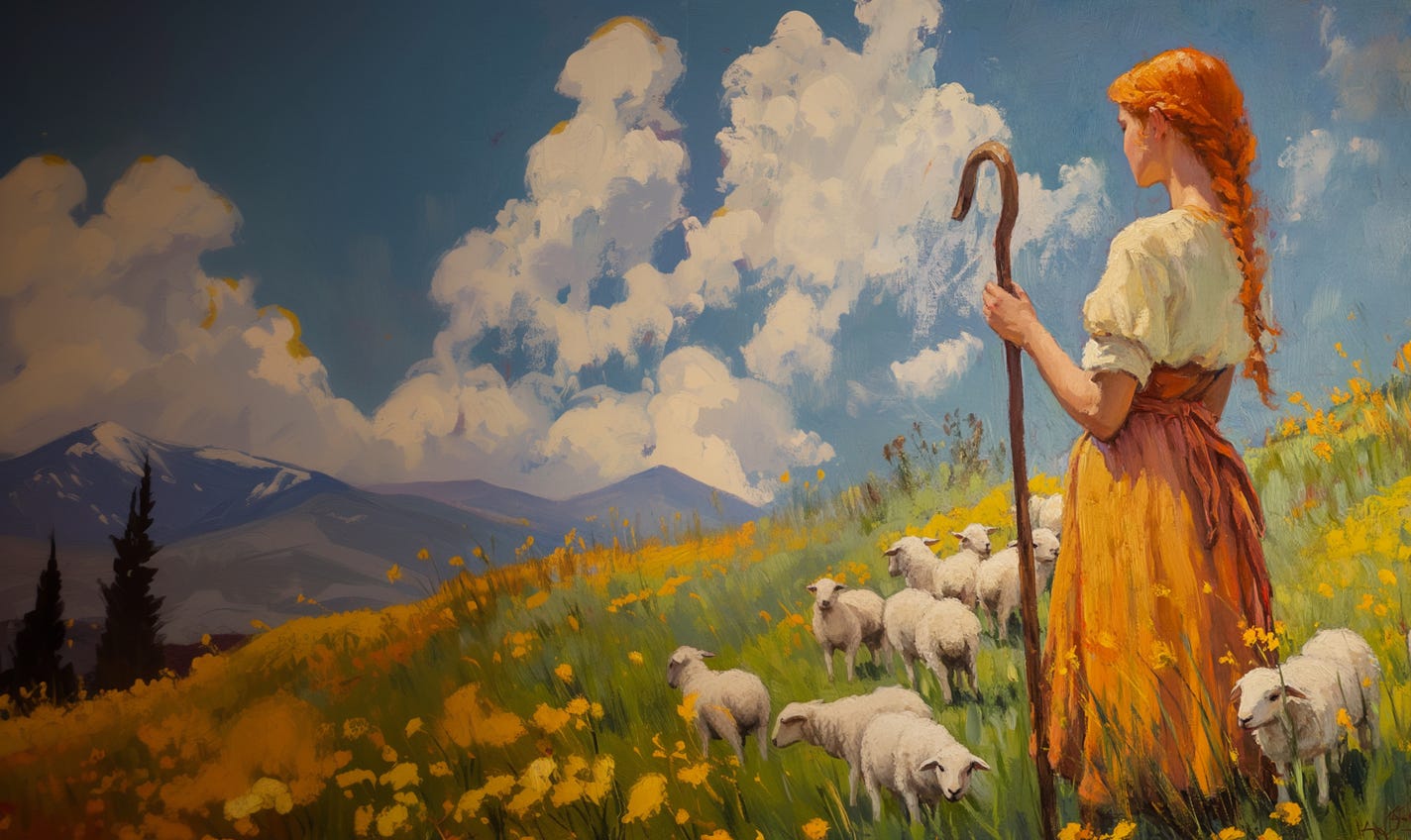
Welcome to the farm, today, where I'm leaning on my oak crook and feeling the gentle breeze in my hair and watching the lambs cavort. I'm also keeping a weather-eye on the sky, and listening to the animals as they move from place to place. Amanda's dealing with real life, and I'm lost in a memory...
A bellwether, in shepherding terms, is the leader of the flock. It would either be a sheep or a goat, depending on the sort of herd (and some weight given to the native intelligence of the animal individually) and it wore a bell on a collar. The bellwether was the critter always out in front, and the rest of the herd would slowly drift in his wake, nibbling and straying, but driven by their instincts to stay with the bell, with the herd. The shepherd (or goatherd. Anyone read Heidi, rather than watching the saccharine movie? Did you know there are sequels?) would follow along after the bell, keeping an eye out for strays or lambs that didn’t know enough to follow the bellwether.
In business terms, the bellwether is the indicator of a trend. In publishing, it currently seems to be ebooks. I posted Dorothy Grant’s post about the implications of the recent Author Earnings report on my facebook timeline, and got a comment: “her article is not correct in its specifics. The graphs are about Kindle ebook sales, not books in general.” My immediate answer, which then led to this post, was ‘That's because there is NO way to get accurate data on books in general, so the bellwether is ebooks, which are trackable.’
See, here’s the thing. Print books are, in theory, externally trackable through the Nielsen BookScan data, which is notoriously unreliable. In theory, publishers ought to know what their sales numbers are, but there are two problems with that data. First, they aren’t going to release proprietary and sensitive information to the public. Secondly, publishers themselves often rely on BookScan, and as Dorie Clark writing for the Harvard Business Review put it “Shockingly” slow and outmoded: “Publishing through a traditional house? Most of us get weekly Nielsen BookScan reports—courtesy of Amazon—and sales figures every six months from our publisher.” Studies compiling data from both BookScan and the Association of American Publishers have ‘holes’ in their data. “The AAP and Nielsen data, while providing useful information that can point to important trends, does have some holes. As mentioned, AAP data doesn’t cover the entire industry, while Nielsen BookScan data doesn’t cover e-books. And lack of reliable e-book data is the most important omission.”
And here is where the most recent Author Earnings Report comes in. “Here at AE, over the last seven quarters we have steadily built up a comprehensive database of quarterly cross-sectional snapshots of the Kindle store, each of which captures between 45% and 60% of Amazon’s daily ebook sales. And while Amazon’s Kindle store alone doesn’t comprise the entire US ebook market, it does account for 67% of all traditionally-published ebook sales…”
While that might not seem enough, as the report points out, it is better than the claims being made on less data by PubTrack.
“The confusion is worsened by Nielsen’s misleading claims about their new PubTrack data products, which sell statistics about the US ebook market. PubTrack collects ebook unit-sales data from “a panel of over thirty US publishers,” according to Nielsen, who then sells that data back to the publishing industry at large. The fact that those Nielsen ebook sales numbers come from only 30 publishers, however, doesn’t stop Nielsen from claiming that their PubTrack numbers represent “85% of the nation’s eBook sales” and drawing broad and unsubstantiated conclusions from them.”
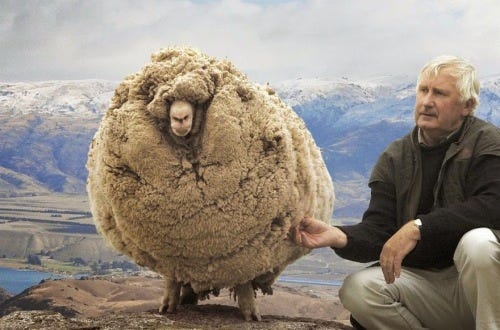
So if we go back to the bellwether metaphor, and the shepherd trying to keep track of his flock, we suddenly see that print data is like a sheep wrapped up in an invisibility cloak, trying to avoid his annual haircut.
I ran across an article very recently, and as I was assembling the material for this post about sheep, goats, and books, I knew I had to include the concept of scapegoats. In the publishing industry, the scapegoats are the books and authors that pay for other books and authors to be published. Oh, they aren’t given any choice, not any more than the goat which was symbolically bound with the sins of the people, and then sent into the wilderness to die alone.
Instead, the popular, best-selling books, are bound with the production and promotion costs of the prestigious and award winning books. “Washington Post critic Ron Charles reviews the kinds of books that get nominated for literary awards. These are not the blockbusters, the books written by the likes of Stephen King and Nora Roberts that make millions. Charles knows that. Even so, he was dismayed when he saw a story about the sales figures for the novels long-listed for the Man Booker. The list included The Green Road by Irish author Anne Enright, who's won the award before. "When I saw that Anne Enright — [who] I think of as giant in literary fiction, beloved around the world — could only sell 9,000 copies in the U.K. I was shocked, that's really low," he says.”
The numbers for the potential Man Booker Prize winners? Tyler’s book has sold 20,102 copies in total across all editions through Nielsen BookScan. As well as being the biggest selling book of the Man Booker Dozen, it is also the book which has seen the most copies sold since the longlist was announced in July – selling 7,680 copies since then. Most of this is down to the release of the paperback last week, which sold 7,115 copies.
Anne Enright’s The Green Road (Jonathan Cape) has sold 2,355 extra copies since being longlisted, for a total of 8,938.
Hanya Yanigahara’s A Little Life (Picador), which was published three weeks after the longlist announcement, has sold a strong 7,542 copies since 13th August. Yanigahara’s book is currently the favourite to win the prize at William Hill, with odds of 2/1 at William Hill, while Paddy Power is offering odds of 9/5.
A Brief History of Seven Killings by Marlon James (Oneworld Publications) has sold 6,694 copies across all editions in total, more than double (3,471 extra) what it had sold before the announcement.
Andrew O’Hagan’s The Illuminations (Faber & Faber), has sold 457 copies since the longlist was announced, for a total of 3,273 copies.
Lila by Marilynne Robinson (Virago) has also sold strongly with 12,184 copies total for the hardback, but only 625 copies are from after it was included on the longlist.
Tom McCarthy’s Satin Island (Jonathan Cape) has sold an additional 589 copies, going from 922 before the announcement to 1,511.
The Year of the Runaways by Sunjeev Sahota (Picador) had sold 413 copies before the announcement and is now on 1,302, an increase of 889 copies and Anna Smaill’s The Chimes (Sceptre) has risen almost as much - from 411 to 1,008.”
So the books that pay off for the publisher obviously subsidize the books that are published solely on ‘literary merit’ and the scapegoat trots off blithely into the desert to take his chances with the fickle public. With the rise of Indie Publishing, the scapegoat is no longer a necessary thing. No one can force an independent to bear the burdens of his less fortunate fellow authors, who write for awards rather than to sell books and make money.
The flock is hearing that bell jingle, and they are changing their path to follow him toward the good green pastures. “It’s a world where authors with plenty of Big 5 sales experience choose to say, 'You know what, I’m not playing this game any more.' Where authors make a positive choice to walk away from the terms offered by good, regular publishers. This new era of publishing is one where authors have a meaningful choice.”
I spent a couple of years as an apprentice shepherdess when I was a teenager. I grew up with a small flock of goats, and I can assure you that not all sheep are dumb, the flock instinct much-mocked is a vital survival tool for them. Goats, kept with sheep, quickly become the trouble-makers, the leaders of the flock, which is why one is usually the bellwether. The goats, in the publishing world, are the early-adopter Indie authors, getting through the fences any way they can to reach the less-worn down grass. The goats know where the noms are, and the sheep will follow them around the gatekeepers. In publishing, we follow that bell to the market.
And finally, don’t stop listening for the bellwether. Today, it’s ebooks and Amazon. But take your attention off the market indicators, and you might lose track of the flock and get too far from the market, getting lost in the process. Amazon might not always provide the greenest pasture, so pay attention to the industry blogs, keep up with the data, and don’t be afraid to move closer to the leading edge. Maybe you can be the bellwether for a while.