

Book Review: Through the Language Glass
The interconnections of words, culture, and the brain

As with any book review, I bought a copy of this for my own purposes. However, the link back to Amazon is an affiliate link and does help support the blog if you purchase through it, so thank you!
I’ve long been interested in language, as you likely guessed from my profession as a writer. Specifically I favor English, because I was born into that language. As Guy Deutscher points out in this book, Through the Language Glass, the mother tongue a person is born into affects far more than just how they talk. He begins by exploring the historical starting with Gladstone’s comments on language in ancient times, and brings it back around in a moebius twist to the same point, but an opposite conclusion about Homer’s great works and his use of colors - or rather, the lack of them.
I enjoy linguistics, but I am also an artist, and it was about this point that I got laser-focused on this book, fascinated by the discussion of colors, names, and how even do some societies get by without words for… green? Or blue? Do they not have artists? The author does not address this. Instead, in this wonderfully written book, he lays out the three places where language diverges from culture to culture, and looks at how this may affect the people who speak a language in discerning the world around them.
When I call it wonderfully written, I mean this topic could have been dry as the dust of the Sahara, but the author has brought a certain sardonic dark humor into the pages which amused me greatly and made the subjects much more readable when they are crafted around both academic rigor and that warm wry sense of the way the world actually works.
I would always say that time spent in reading about language is important to a writer. For myself, the more I spend thinking about how language works, the better I am at construction of sentences and paragraphs de novo while I am in the act of writing. With this book diving into the way many different cultures think (or don’t) about the words they choose to use, it also opens up character development when I am writing peoples of differing cultures, helping me craft them more believably. I hope. It is my intent, at least.
Aside from my interest in this book as a craftswoman, I have been aware for some decades of attempts to manipulate my own culture, of the United States of America’s brand of spoken and written English. I have objected to this in small ways, see above my use of the word craftswoman, rather than, say, craftsperson? In reality, I am a craftsman, because the word does not dictate my sex (female) but merely indicated that I am a human (man). I’m pushing back, in my own ways and words, against the compelled speech which attempts to change culture through language.
“no list of such blunders could be complete without George Orwell’s novel 1984, where the political rulers have such faith in the power of language that they assume political dissent could be entirely eliminated if only all offending words could be expunged from the vocabulary. “In the end we shall make thoughtcrime literally impossible, because there will be no words in which to express it.” But why stop there? Why not abolish the word “greed” as a quick fix for the world’s economy, or do away with the word “pain” to save billions on aspirin, or confine the word “death” to the garbage can as an instant formula for universal immortality?”
— Through the Language Glass: Why the World Looks Different in Other Languages by Guy Deutscher
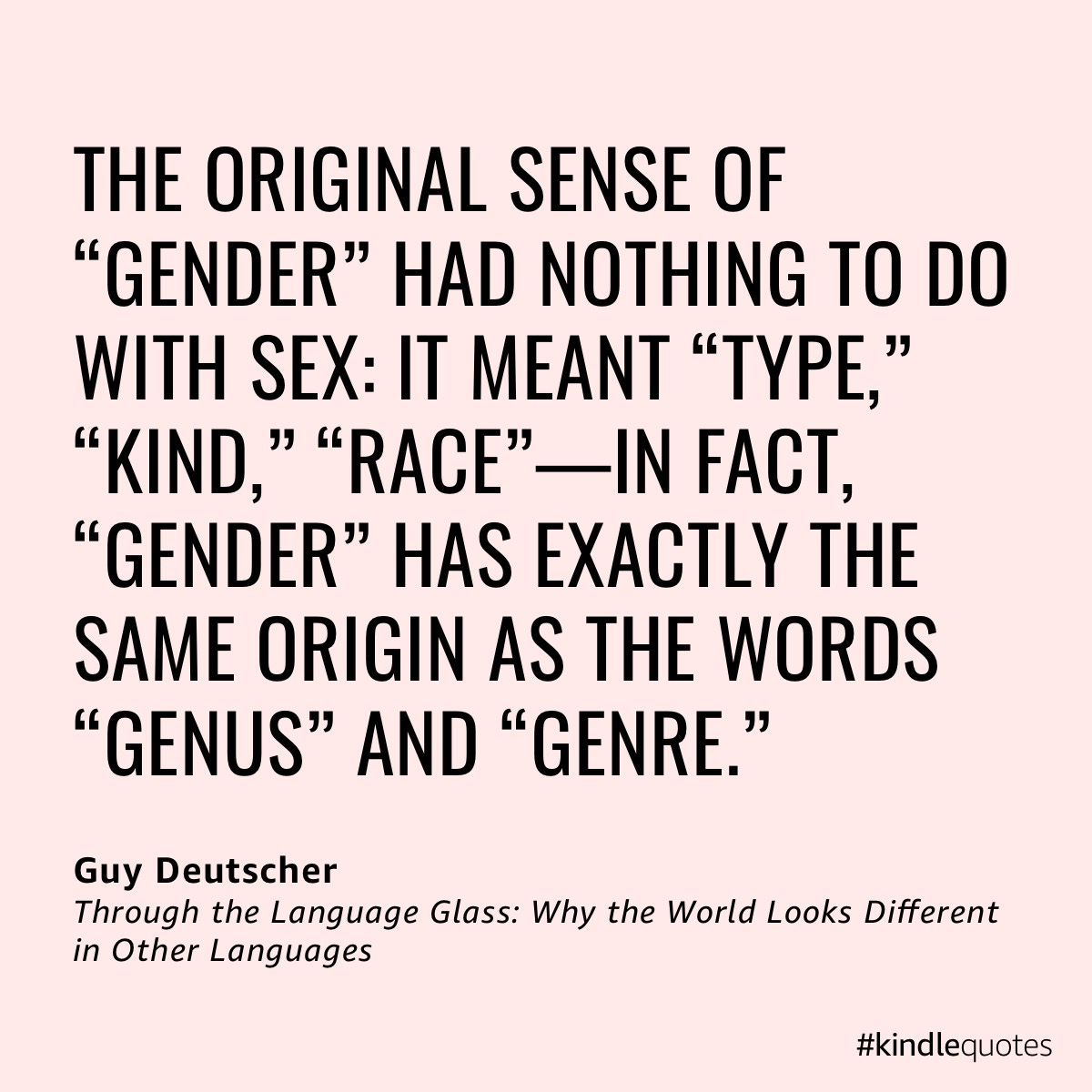
“Like most serious problems in life, the latter-day diversity of meanings for “gender” has its roots in ancient Greece. The Greek philosophers started using their noun génos (which meant “race” or “type”) to refer to one particular division of things into three specific “types”: males (humans and animals), females, and inanimate things. And from Greek, this sense passed via Latin to other European languages. In English, both senses of “gender”—the general meaning “type” and the more specific grammatical distinction—coexisted happily for a long time. As late as the eighteenth century, “gender” could still be used in an entirely sexless way. When the novelist Robert Bage wrote in 1784, “I also am a man of importance, a public man, Sir, of the patriotic gender,” he meant nothing more than “type.” But later on, this general sense of the word fell into disuse in everyday English, the “neuter” category also beat a retreat, and the masculine-feminine division came to dominate the meaning of the word. In the twentieth century, “gender” became simply a euphemism for “sex,” so if you find on some official form a request to fill in your “gender,” you are unlikely nowadays to write “patriotic.””
— Through the Language Glass: Why the World Looks Different in Other Languages by Guy Deutscher
By my having concentrated those quotes in one place, you may be forgiven for thinking the author polemical, which is far from the case. He points out, quite correctly, that in linguistics the use of gender is very complicated, has nothing to do with sex, and like color, is a key way of understanding how language can and does form perceptions of the world around a person who speaks that language natively. He is also, as you will learn partway through the book, not a native English speaker, but was born and raised speaking Hebrew, giving him a very interesting slant on language.
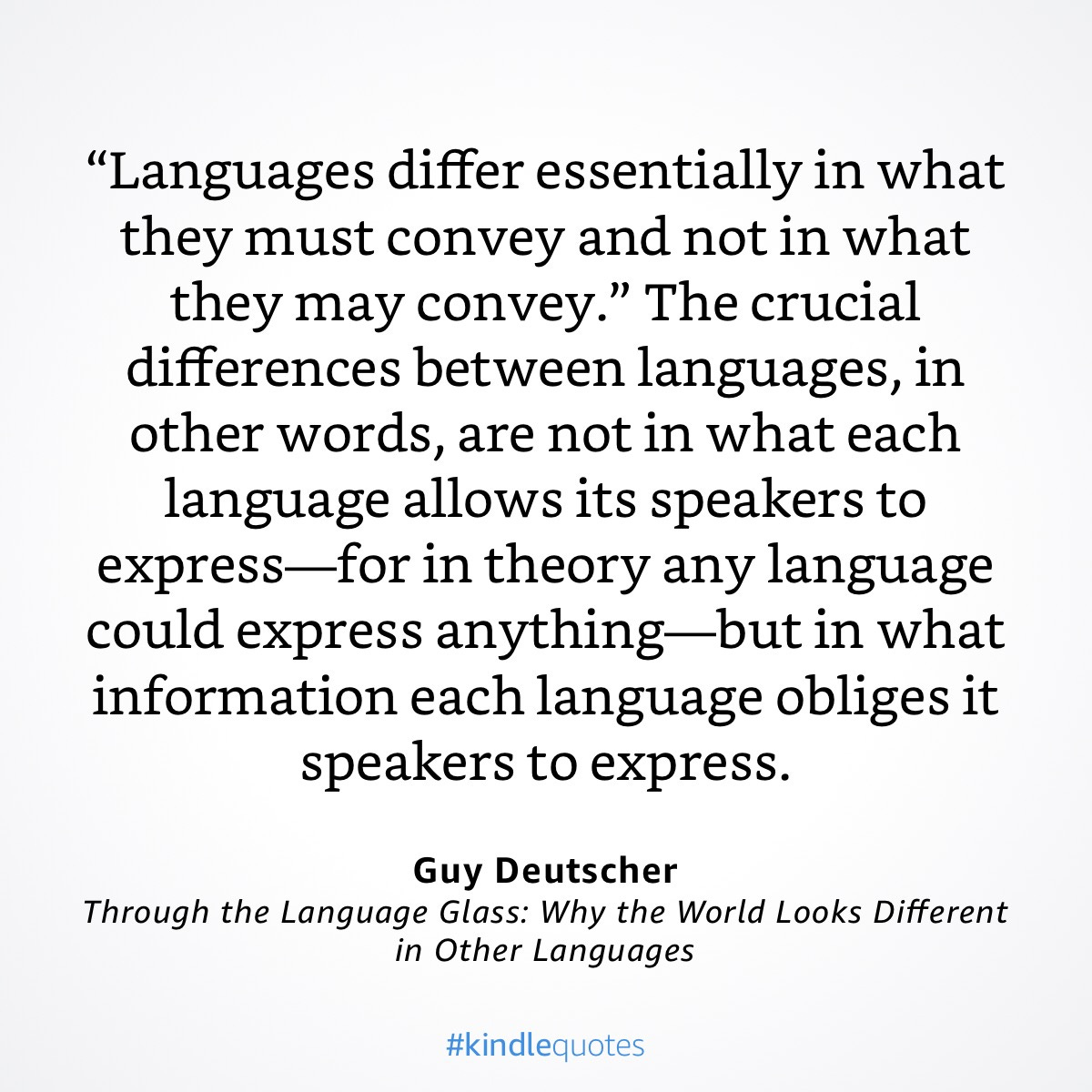
I think you have already gathered that I do recommend this book. If you are interested in language, in cultural differences, in the ways words work with both those things, then you will likely enjoy reading this book. Even if all you want to do is better craft characters as a writer, I still think you can do far worse than reading this book to make you think about the differences in speech which can trip up your story and give interesting little frictions between characters. Even if you are not a writer, and just interacting with real people out in the real world, this may give you some insight into what they are trying to say. Into what is so carefully being inserted into the culture wars on an almost subliminal level with word choices.
Through the Language Glass: Why the World Looks Different in Other Languages by Guy Deutscher
Solid review. The Gladstone-to-Homer thread is such a clean entry point for unpacking how langauge and perception intersect. What really works here is the tension between whether societies lack words for colors or whether they simply categorize them diferently, which cuts to the core of linguistic relativity without getting bogged down in abstraction.
"Aside from my interest in this book as a craftswoman..." You had me wondering.... Clever. It was a trap. ☺
The book looks fascinating. Have been a word and language junkie/hobbyist for many decades...much a the good it done me. Found a used copy of the book on Amazon for $5.19. Thanks.